Public Business Email Addresses Do Not Constitute Marketing Consent: What Companies Must Know About B2B Email Outreach
Monday, November 2, 2026
Business email addresses can be found in seconds today: on contact pages, in website legal notices (Impressum), in industry directories, or through prospecting and sales intelligence tools. This gives rise to a widespread misconception: if an address is publicly accessible, it must be fair game for outreach. When it comes to marketing emails, that sweeping assumption is simply incorrect under German law.
For businesses, this distinction has major practical implications, as modern sales software can quickly turn a single legal misstep into hundreds or thousands of non-compliant messages. What matters is not merely whether an address is technically reachable, but whether the specific commercial outreach is legally permissible. In this context, the German Act Against Unfair Competition (UWG) and—where personal contact data is involved—the General Data Protection Regulation (GDPR) must be evaluated separately.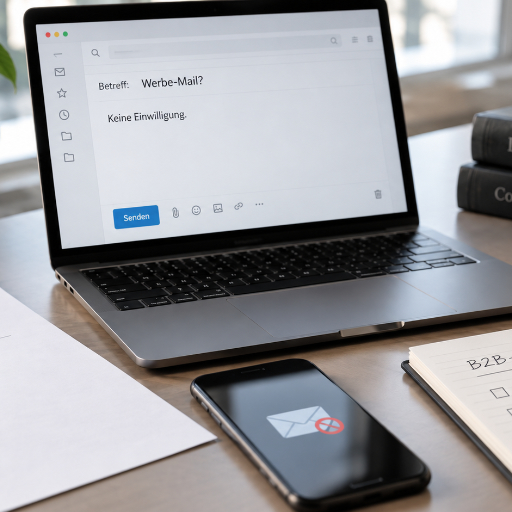
This is the fundamental distinction: publishing an email address merely answers how a company can be contacted. Advertising consent, by contrast, determines whether the recipient has specifically agreed to receive promotional electronic mail. The two are by no means the same.
This applies even if the address is easy to find, such as info@company.de, sales@company.de, or firstname.lastname@company.de. Sourcing an address publicly does not eliminate the requirement to verify whether sending the intended message is legally permitted.
For marketing phone calls to other market participants, presumed consent may suffice under certain conditions pursuant to Section 7 (2) No. 1 UWG. For advertising via electronic mail, however, Section 7 (2) No. 2 UWG strictly requires prior express consent from the recipient. The presumed-consent rationale commonly applied to B2B phone calls cannot simply be transferred to cold emails.
This does not mean that every business email constitutes advertising. A specific response to an inquiry, contractual communication, or a purely factual notification may be classified differently. However, as soon as a message is intended—directly or indirectly—to promote the sale of goods or services, it must be evaluated as promotional communication.
Conversely, a marketing email does not become legally permissible simply because it is individually drafted, sent only once, or accompanied by a polite opt-out note. A disclaimer like “If this isn't relevant, just let me know” does not substitute for the required prior consent.
For marketing and sales teams, a practical litmus test helps: Would this message still be sent if there were zero chance of generating a business opportunity from it? If the answer is no, strong reasons exist to treat the communication as advertising and evaluate the legal requirements accordingly.
If even one of these criteria is missing, the existing customer exemption does not justify the mailing. A prior inquiry, trade fair contact, free download, or casual exchange of business cards does not automatically satisfy these four cumulative requirements.
Recital 47 of the GDPR identifies direct marketing as a potential legitimate interest. However, this does not mean that all direct marketing is automatically lawful under data protection law. Art. 6(1)(f) GDPR requires a documented balancing of interests. Furthermore, establishing a lawful basis under data protection law does not override or satisfy the unfair competition requirements of Section 7 UWG.
Anyone who harvests personal contact details from publicly available sources must also comply with GDPR transparency and information requirements. When personal data has not been obtained directly from the data subject, Art. 14 GDPR is especially relevant. For direct marketing, Art. 21 GDPR is equally pivotal: if the data subject objects to processing for marketing purposes, their personal data may no longer be processed for those ends.
Generic functional mailboxes such as info@company.de do not always allow the identification of a natural person, which may change the GDPR assessment. However, the strict rules of Section 7 UWG regarding promotional email remain fully applicable regardless.
If a flawed assumption—such as “address found in the Impressum = cold outreach allowed”—is baked into an automated workflow, that error replicates across every single record. For this reason, a compliance review should not occur at the end of a campaign, but must be engineered directly into the data and sending logic.
That final point is often overlooked in automated pipelines. A CRM field reading “Source: Website” merely records where an address was located; it proves zero consent to receive promotional emails.
Businesses seeking a structured evaluation of such messages can find information and a review process for unsolicited promotional emails at Legalano. Legalano is not a law firm; eligible inquiries are routed to independent legal service partners.
For businesses, the sequence is critical: first establish consent, statutory exemptions, data provenance, and opt-out management—and only then scale automation, personalization, and sending volume. This not only mitigates legal exposure, but also improves data hygiene and compels sales teams to target higher-quality prospects.
Not simply because the address is publicly visible. Even a single marketing email generally falls under Section 7 (2) No. 2 UWG. The German Federal Court of Justice (BGH) has established that unsolicited commercial email advertising can constitute an unlawful interference with an established and operating commercial enterprise.
Is an unsubscribe link or a note saying “reply if not interested” sufficient?
No, not if prior express consent was required for the initial email. An opt-out mechanism is mandatory, but it does not cure the absence of required upfront consent.
Does finding an address in an Impressum or on LinkedIn count as consent?
No. Public visibility merely indicates that an address is accessible. Using it for promotional purposes requires independent verification of prior consent or an applicable statutory exemption.
Can I email existing customers about similar offerings?
Yes, provided all cumulative conditions under Section 7 (3) UWG are met. Specifically, the email address must have been collected in connection with a sale, promote only the company's own similar goods or services, and include the legally mandated opt-out notices.
Does the GDPR apply in addition to the UWG?
Yes, in cases involving personal contact data. The GDPR governs the processing of personal data, while the UWG governs the permissibility of promotional communication. A lawful basis under the GDPR does not waive or satisfy the statutory requirements of Section 7 UWG.
About the author: Deniss Danilciks is the Managing Director of Teloro GmbH in Mannheim and the operator of Legalano. Legalano assists companies with the structured documentation of cases involving unsolicited commercial emails and routes eligible inquiries to independent legal service partners. Legalano is not a law firm.
Image credit: Legalano / Teloro GmbH – proprietary graphic, 2026.
Note: This article is provided for general informational purposes only and does not constitute formal legal advice for individual cases. As of: September 2026.
For businesses, this distinction has major practical implications, as modern sales software can quickly turn a single legal misstep into hundreds or thousands of non-compliant messages. What matters is not merely whether an address is technically reachable, but whether the specific commercial outreach is legally permissible. In this context, the German Act Against Unfair Competition (UWG) and—where personal contact data is involved—the General Data Protection Regulation (GDPR) must be evaluated separately.
Accessible Does Not Mean Approved for Advertising
A business website publishes an email address primarily so that customers, prospective clients, business partners, or other parties can get in touch. For commercial digital services, providing an electronic mail address is even part of the mandatory contact information required under Section 5 DDG. However, fulfilling this legal disclosure duty does not grant blanket consent to receive promotional messages.This is the fundamental distinction: publishing an email address merely answers how a company can be contacted. Advertising consent, by contrast, determines whether the recipient has specifically agreed to receive promotional electronic mail. The two are by no means the same.
This applies even if the address is easy to find, such as info@company.de, sales@company.de, or firstname.lastname@company.de. Sourcing an address publicly does not eliminate the requirement to verify whether sending the intended message is legally permitted.
B2B Email Outreach Is Not Automatically More Lenient Than B2C
A persistent belief in sales is that businesses can freely market to one another via email without consent. However, Section 7 UWG draws a sharp legal distinction between telephone marketing and electronic mail.For marketing phone calls to other market participants, presumed consent may suffice under certain conditions pursuant to Section 7 (2) No. 1 UWG. For advertising via electronic mail, however, Section 7 (2) No. 2 UWG strictly requires prior express consent from the recipient. The presumed-consent rationale commonly applied to B2B phone calls cannot simply be transferred to cold emails.
This does not mean that every business email constitutes advertising. A specific response to an inquiry, contractual communication, or a purely factual notification may be classified differently. However, as soon as a message is intended—directly or indirectly—to promote the sale of goods or services, it must be evaluated as promotional communication.
The Commercial Purpose Matters, Not the Subject Line
Advertising does not have to look like a traditional newsletter. A personalized message with a subject line such as “Quick question,” “Partnership opportunity?,” or “15-minute chat?” can still qualify as advertising if its true purpose is to promote a product, service, or introductory sales call.Conversely, a marketing email does not become legally permissible simply because it is individually drafted, sent only once, or accompanied by a polite opt-out note. A disclaimer like “If this isn't relevant, just let me know” does not substitute for the required prior consent.
For marketing and sales teams, a practical litmus test helps: Would this message still be sent if there were zero chance of generating a business opportunity from it? If the answer is no, strong reasons exist to treat the communication as advertising and evaluate the legal requirements accordingly.
The Existing Customer Exemption Is Narrower Than Many Assume
An important exception is set out in Section 7 (3) UWG. Under specific conditions, a company may use an email address obtained in connection with a sale for direct marketing without securing fresh express consent for every individual message. However, all statutory conditions must be satisfied cumulatively:- The customer's email address was obtained in connection with the sale of a good or service.
- The address is used for direct marketing of the company's own similar goods or services.
- The customer has not objected to this use.
- The customer was clearly informed—both when the address was collected and upon every use—that they can object to such use at any time without incurring costs other than transmission costs according to standard rates.
If even one of these criteria is missing, the existing customer exemption does not justify the mailing. A prior inquiry, trade fair contact, free download, or casual exchange of business cards does not automatically satisfy these four cumulative requirements.
GDPR and UWG Address Different Legal Questions
When handling personalized business addresses such as firstname.lastname@company.de, a second legal dimension regularly comes into play: the processing of personal data. In these cases, compliance with the GDPR is required alongside the UWG.Recital 47 of the GDPR identifies direct marketing as a potential legitimate interest. However, this does not mean that all direct marketing is automatically lawful under data protection law. Art. 6(1)(f) GDPR requires a documented balancing of interests. Furthermore, establishing a lawful basis under data protection law does not override or satisfy the unfair competition requirements of Section 7 UWG.
Anyone who harvests personal contact details from publicly available sources must also comply with GDPR transparency and information requirements. When personal data has not been obtained directly from the data subject, Art. 14 GDPR is especially relevant. For direct marketing, Art. 21 GDPR is equally pivotal: if the data subject objects to processing for marketing purposes, their personal data may no longer be processed for those ends.
Generic functional mailboxes such as info@company.de do not always allow the identification of a natural person, which may change the GDPR assessment. However, the strict rules of Section 7 UWG regarding promotional email remain fully applicable regardless.
Why Automation Doesn’t Change the Legal Risk—It Multiplies It
Sales automation, automated CRM sequences, and AI-driven personalization do not alter how a message is legally categorized. Automated outreach can be just as lawful or unlawful as a manually written email. The practical difference lies in scale.If a flawed assumption—such as “address found in the Impressum = cold outreach allowed”—is baked into an automated workflow, that error replicates across every single record. For this reason, a compliance review should not occur at the end of a campaign, but must be engineered directly into the data and sending logic.
A Practical Pre-Send Checklist
For small and medium-sized enterprises, vetting outreach does not need to be overly complicated. Before launching a B2B email campaign, you should evaluate at least the following points:- Commercial purpose: Does the message directly or indirectly promote the sale of goods or services?
- Lawful basis: Is there documented express consent, or are all conditions of Section 7 (3) UWG demonstrably fulfilled?
- Data source: Where was the email address obtained, and for personal data, is a legal basis as well as GDPR-mandated privacy information properly documented?
- Objections and opt-outs: Is there a centralized suppression list that reliably honors newsletter unsubscribes, informal objections, and previous rejections?
- Sender and content transparency: Are the sender's identity and commercial intent clearly stated, and is there an accessible mechanism to opt out of future communications?
- Audit trail: Can the company prove at a later date why this specific recipient was contacted and under what legal justification?
That final point is often overlooked in automated pipelines. A CRM field reading “Source: Website” merely records where an address was located; it proves zero consent to receive promotional emails.
What Recipients of Unsolicited B2B Marketing Can Do
Recipients who receive an unsolicited marketing email should avoid deleting it hastily. The best approach is to preserve the original message including full headers, review any prior business dealings with the sender, and document any previously stated objections. Whether a specific incident is unlawful and what remedies may be available depends on the specific circumstances.Businesses seeking a structured evaluation of such messages can find information and a review process for unsolicited promotional emails at Legalano. Legalano is not a law firm; eligible inquiries are routed to independent legal service partners.
Conclusion: Establish Sending Logic First, Then Scale
B2B email prospecting is an area where “publicly accessible” must never be equated with “permitted for marketing.” Section 7 UWG establishes strict requirements for electronic advertising that apply equally to commercial business relationships. For personal email addresses, the GDPR introduces an additional layer of scrutiny.For businesses, the sequence is critical: first establish consent, statutory exemptions, data provenance, and opt-out management—and only then scale automation, personalization, and sending volume. This not only mitigates legal exposure, but also improves data hygiene and compels sales teams to target higher-quality prospects.
FAQ: Frequently Asked Questions on B2B Email Outreach
Can I use a generic info@ address for a one-time cold email?Not simply because the address is publicly visible. Even a single marketing email generally falls under Section 7 (2) No. 2 UWG. The German Federal Court of Justice (BGH) has established that unsolicited commercial email advertising can constitute an unlawful interference with an established and operating commercial enterprise.
Is an unsubscribe link or a note saying “reply if not interested” sufficient?
No, not if prior express consent was required for the initial email. An opt-out mechanism is mandatory, but it does not cure the absence of required upfront consent.
Does finding an address in an Impressum or on LinkedIn count as consent?
No. Public visibility merely indicates that an address is accessible. Using it for promotional purposes requires independent verification of prior consent or an applicable statutory exemption.
Can I email existing customers about similar offerings?
Yes, provided all cumulative conditions under Section 7 (3) UWG are met. Specifically, the email address must have been collected in connection with a sale, promote only the company's own similar goods or services, and include the legally mandated opt-out notices.
Does the GDPR apply in addition to the UWG?
Yes, in cases involving personal contact data. The GDPR governs the processing of personal data, while the UWG governs the permissibility of promotional communication. A lawful basis under the GDPR does not waive or satisfy the statutory requirements of Section 7 UWG.
About the author: Deniss Danilciks is the Managing Director of Teloro GmbH in Mannheim and the operator of Legalano. Legalano assists companies with the structured documentation of cases involving unsolicited commercial emails and routes eligible inquiries to independent legal service partners. Legalano is not a law firm.
Image credit: Legalano / Teloro GmbH – proprietary graphic, 2026.
Note: This article is provided for general informational purposes only and does not constitute formal legal advice for individual cases. As of: September 2026.