Acrylic glass, Alu-Dibond, or PVC foam board? The right material for your company sign-practical comparison
Saturday, August 1, 2026
You often see it when walking through commercial areas or looking at the facades of medical centers: signs that warp unpleasantly forward in the summer sun. PVC foam boards showing fine cracks around the drill holes. Or high-gloss surfaces where the company name is barely legible due to extreme reflections.
Usually, these are not production errors by the printing company. They are the result of choosing the wrong material.
A signage system is often ordered based purely on the visual draft on a monitor. But whether the design actually works on the wall and remains presentable for years depends largely on the backing panel. In professional sign making, three standards have established themselves for this purpose: Alu-Dibond, acrylic glass, and PVC foam board.
Which material is the best choice for your law firm, medical practice, or retail store comes down to three simple factors: location, lighting conditions, and brand message.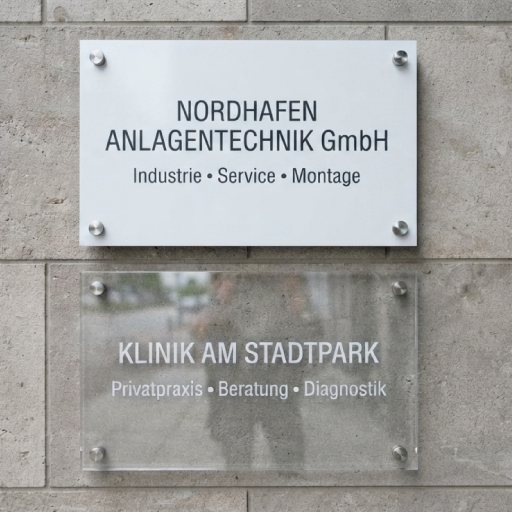
Ideal for: Craft businesses, industrial halls, parking lot directional signs, and modern agencies.
An important practical tip: Acrylic glass reflects. In corridors with many direct-beam ceiling spots or opposite large windows, this can restrict readability. In extremely bright environments, matte Alu-Dibond is often the better choice. Furthermore, acrylic glass must never be cleaned with abrasive or highly solvent-based agents, otherwise, it will become "cloudy".
Ideal for: Construction site signs, exhibition walls, directional signs during company relocations, or temporary promotional signage in retail.
The Fit to the Brand Message
A metal construction company or a hip tech startup often looks out of place on delicate, glossy acrylic glass. Here, Alu-Dibond – perhaps even in the version with a brushed aluminum surface (butler finish) – fits the core message much better. Conversely, a beauty clinic quickly appears too cold and technical on industrial aluminum.
Size Dictates the Material
A small door sign (e.g., 30 x 20 cm) works perfectly in 4 mm thick acrylic glass. However, if you are planning a 3 x 1 meter company sign on the street, plastic is completely ruled out due to its lack of stability. Here, you absolutely need the rigidity of Alu-Dibond.
Room to Make an Impact: The Right Mounting
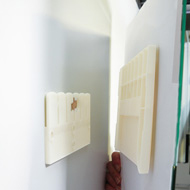
The best sign loses its impact if corners are cut on mounting. A serious mistake is screwing an elegant design flush against uneven woodchip wallpaper or using cheap plastic caps.
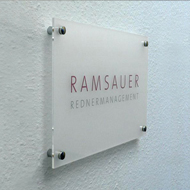
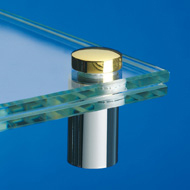
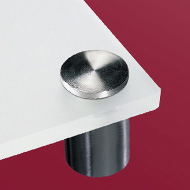
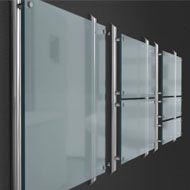
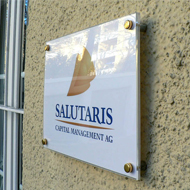
High-quality company signs need space to make an impact. Always use professional stainless steel stand-offs. These create a "shadow gap" between the wall and the sign. Thanks to the natural shadowing, the sign stands out visually and underlines the premium value of your company.
For small door signs (up to approx. DIN A3 size), 3 mm for Alu-Dibond and 4 to 5 mm for acrylic glass are completely sufficient. The larger the sign, the thicker the chosen material should be to prevent sagging. Large acrylic signs for wall mounting look particularly solid starting from a thickness of 8 to 10 mm.
Can I also hang acrylic glass outdoors?
Yes. The material itself (PMMA) is naturally extremely UV-resistant and does not yellow. However, it is crucial that the printing inks are certified for outdoor use (e.g., UV direct printing). For unprotected outdoor areas with high mechanical stress, Alu-Dibond remains the safer choice.
Which material is suitable for illuminated signs?
If the sign is to be backlit (e.g., as a lightbox), you need translucent acrylic or opal glass. Alu-Dibond is 100% opaque and is only suitable if the sign is illuminated from the outside with spotlights.
What is the difference between acrylic glass and Plexiglas?
From a material perspective, there is no difference. Acrylic glass (polymethyl methacrylate) is the general chemical name. Plexiglas® is simply a protected brand name of Röhm GmbH for this material – much like people often say "Kleenex" when they mean facial tissues.
Usually, these are not production errors by the printing company. They are the result of choosing the wrong material.
A signage system is often ordered based purely on the visual draft on a monitor. But whether the design actually works on the wall and remains presentable for years depends largely on the backing panel. In professional sign making, three standards have established themselves for this purpose: Alu-Dibond, acrylic glass, and PVC foam board.
Which material is the best choice for your law firm, medical practice, or retail store comes down to three simple factors: location, lighting conditions, and brand message.
Alu-Dibond: Robustness and Dimensional Stability for Outdoor Use
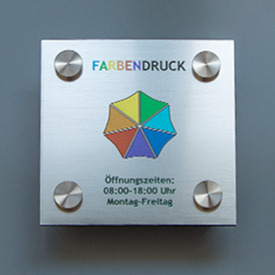
When sign makers give a recommendation for outdoor use, the name Alu-Dibond is almost always the first to be mentioned. Behind this is a so-called sandwich panel: a solid, hard polyethylene core is enclosed on both sides by wafer-thin aluminum cover sheets. This construction makes the material surprisingly lightweight, yet extremely rigid. Even with large-format signs spanning several meters in width, nothing sags. Aluminum does not rust and hardly expands under severe temperature fluctuations. It does not warp in midsummer and does not become brittle in winter. Visually, Alu-Dibond offers a rather functional, standard matte finish. This is a huge advantage outdoors, as sunlight is barely reflected and the sign remains readable from any angle. Those specifically looking for a weatherproof solution are investing in signage that will last for many years on the facade with classic Alu-Dibond outdoor signs.Ideal for: Craft businesses, industrial halls, parking lot directional signs, and modern agencies.
Acrylic Glass: Maximum Depth Effect for a Premium Appearance
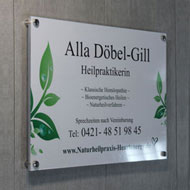
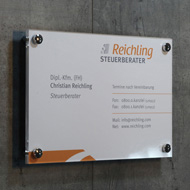
While Alu-Dibond shines with robust durability, acrylic glass plays to its strengths in pure visual elegance. The material is significantly more break-resistant than real glass, but offers the same flawless, glossy surface. The decisive advantage in production is sub-surface printing. The motif is not printed on the front, but is laminated or printed in reverse on the back of the transparent panel. The viewer therefore looks at the logo through 4 to 10 mm of solid material. This creates a brilliant, three-dimensional depth effect that simultaneously protects the print perfectly from scratches. For this reason, doctors, notaries, and management consultancies almost exclusively opt for acrylic glass practice signs for their indoor spaces.An important practical tip: Acrylic glass reflects. In corridors with many direct-beam ceiling spots or opposite large windows, this can restrict readability. In extremely bright environments, matte Alu-Dibond is often the better choice. Furthermore, acrylic glass must never be cleaned with abrasive or highly solvent-based agents, otherwise, it will become "cloudy".
PVC Foam Board: The Specialist for Short-Term Use
If you search the web for "plastic signs", in practice you usually end up with PVC foam boards (known by brand names like Forex). They are feather-light, extremely easy to process, and noticeably easy on the budget. However, the material has physical limits for permanent outdoor use. If such a sign hangs unprotected on a south-facing exterior wall, it will soften in the heat and can wave or warp. PVC foam board shows its true strength where speed and temporary cost-effectiveness are key.Ideal for: Construction site signs, exhibition walls, directional signs during company relocations, or temporary promotional signage in retail.
Data & Features: The Materials in Direct Comparison
| Feature | Alu-Dibond | Acrylic Glass | PVC Foam Board |
| Appearance & Effect | Matte, functional, reflection-free | High-gloss, elegant (depth effect) | Silk-matte, simple |
| Dimensional Stability | Very high (rigid) | High (with sufficient thickness) | Low (can deform in heat) |
| Weather Resistance | Excellent | Very good | Moderate (only temporary outdoors) |
| Weight | Medium | Medium to heavy | Very light |
| Typical Thicknesses | 3 mm to 4 mm | 4 mm to 10 mm | 3 mm to 10 mm |
| Price Level | Medium to premium | Premium | Inexpensive |
Decision-Making Guide: How to Avoid Typical Bad Purchases
Technical data is one thing. But how do you make the right decision for your specific project? Pay attention to these three aspects, which are often overlooked in everyday agency life:The Fit to the Brand Message
A metal construction company or a hip tech startup often looks out of place on delicate, glossy acrylic glass. Here, Alu-Dibond – perhaps even in the version with a brushed aluminum surface (butler finish) – fits the core message much better. Conversely, a beauty clinic quickly appears too cold and technical on industrial aluminum.
Size Dictates the Material
A small door sign (e.g., 30 x 20 cm) works perfectly in 4 mm thick acrylic glass. However, if you are planning a 3 x 1 meter company sign on the street, plastic is completely ruled out due to its lack of stability. Here, you absolutely need the rigidity of Alu-Dibond.
Room to Make an Impact: The Right Mounting
The best sign loses its impact if corners are cut on mounting. A serious mistake is screwing an elegant design flush against uneven woodchip wallpaper or using cheap plastic caps.
High-quality company signs need space to make an impact. Always use professional stainless steel stand-offs. These create a "shadow gap" between the wall and the sign. Thanks to the natural shadowing, the sign stands out visually and underlines the premium value of your company.
Your Path to the Perfect Signage System
The choice of material is not purely a matter of taste, but an interplay of location, lighting, and longevity. If you want to play it safe outdoors, reach for Alu-Dibond. If you want to leave an exclusive first impression indoors, choose acrylic glass. If you are still unsure, it is worth making an exact comparison with specialized signage providers before ordering. There, you can directly compare the various materials, printing methods (such as UV direct printing), and mounting options to configure your custom professional solution.FAQ: Frequently Asked Questions About Ordering Signs
How thick should a company sign be?For small door signs (up to approx. DIN A3 size), 3 mm for Alu-Dibond and 4 to 5 mm for acrylic glass are completely sufficient. The larger the sign, the thicker the chosen material should be to prevent sagging. Large acrylic signs for wall mounting look particularly solid starting from a thickness of 8 to 10 mm.
Can I also hang acrylic glass outdoors?
Yes. The material itself (PMMA) is naturally extremely UV-resistant and does not yellow. However, it is crucial that the printing inks are certified for outdoor use (e.g., UV direct printing). For unprotected outdoor areas with high mechanical stress, Alu-Dibond remains the safer choice.
Which material is suitable for illuminated signs?
If the sign is to be backlit (e.g., as a lightbox), you need translucent acrylic or opal glass. Alu-Dibond is 100% opaque and is only suitable if the sign is illuminated from the outside with spotlights.
What is the difference between acrylic glass and Plexiglas?
From a material perspective, there is no difference. Acrylic glass (polymethyl methacrylate) is the general chemical name. Plexiglas® is simply a protected brand name of Röhm GmbH for this material – much like people often say "Kleenex" when they mean facial tissues.